
The 1980s began with English dominance and ended with Sacchi's Milan. In between came the Heysel tragedy, the first great penalty-shootout dramas and new champions from Romania, Portugal and the Netherlands. For us it holds something special too: the 1983 final at the Athens Olympic Stadium.
1980 · Madrid: Nottingham Forest – Hamburg 1-0
On 28 May 1980, at the Bernabéu, John Robertson scored inside the first 20 minutes and Forest defended solidly to the end. Brian Clough celebrated a second trophy in a row against a Hamburg side that included former Liverpool player Kevin Keegan.
Because of the Madrid heat, Forest's red shirt had a larger V-neck than usual.
1981 · Paris: Liverpool – Real Madrid 1-0
On 27 May 1981, at the Parc des Princes, the game looked locked. Just after the 80th minute, left-back Alan Kennedy, who had been out for six weeks with a broken wrist, collected a throw-in and beat Agustín.
Bob Paisley became the first manager to win three European Cups. According to Historical Football Kits, Liverpool taped over the Umbro logos on their red shirts, against Real's white.
1982 · Rotterdam: Aston Villa – Bayern 1-0
On 26 May 1982 Villa goalkeeper Jimmy Rimmer injured his shoulder after ten minutes. Nigel Spink came on, in only his second first-team appearance, and kept Bayern out.
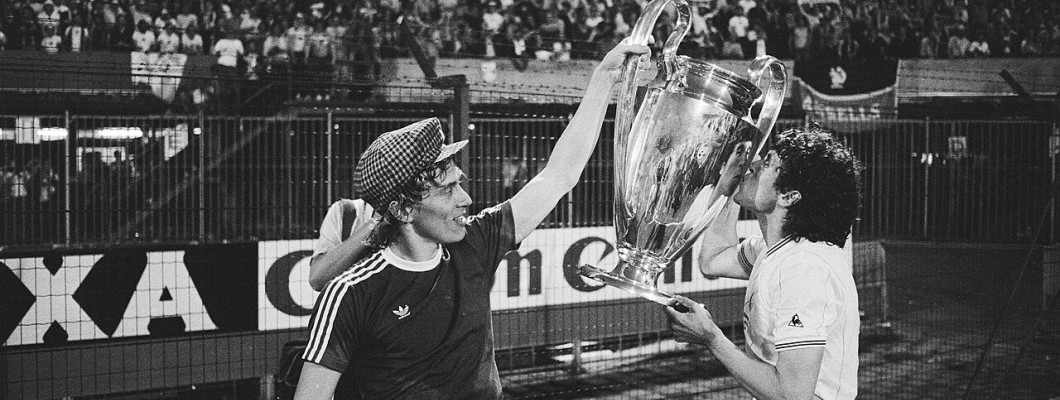
On 67 minutes Peter Withe turned in Tony Morley's cross for Tony Barton's side. After the game several players swapped shirts with the all-red Bavarians, and Withe and Spink later got theirs back.
1983 · Athens: Hamburg – Juventus 1-0
On 25 May 1983 the brand-new "Spyros Louis" Olympic Stadium, inaugurated in September 1982, hosted its first European Cup final. In front of 73,500 spectators, Felix Magath scored in the opening minutes and Hamburg beat Trapattoni's Juventus.
Ernst Happel won the trophy with a second different club, after Feyenoord in 1970. According to Wikipedia's kit graphics, the Germans wore red and the Italians their black-and-white stripes.
It was the sixth final in a row to finish 1-0. Athens would host finals again in 1994 and 2007.
1984 · Rome: Liverpool – Roma 1-1 (4-2 pens)
On 30 May 1984 Roma played a final in their own stadium, the Stadio Olimpico, and were favourites. Phil Neal scored on 13 minutes and Roberto Pruzzo equalised on 42.
In the shootout Bruce Grobbelaar wobbled his legs on the line to put the takers off. Conti and Graziani sent their kicks over, and Alan Kennedy gave Liverpool their fourth title in their red shirts.
1985 · Brussels: Juventus – Liverpool 1-0
In the semi-final Liverpool had knocked out Panathinaikos, winning 4-0 at Anfield and 1-0 at the Athens Olympic Stadium. But on 29 May 1985 the final at the Heysel was marked by tragedy: Liverpool fans broke through the fence into section Z, a wall collapsed and 39 people, 32 of them Italian, lost their lives.
The match kicked off more than an hour late, to prevent further violence. Michel Platini scored a second-half penalty after a foul on Boniek that actually happened outside the box.
English clubs were banned from Europe for five years and Liverpool for six. The stadium was rebuilt in 1994 as the King Baudouin Stadium.
1986 · Seville: Steaua – Barcelona 0-0 (2-0 pens)
On 7 May 1986 Terry Venables's Barcelona were almost at home in Spain. After the first goalless final, it was Helmuth Duckadam's night: he saved all four of the Catalans' penalties.
Majearu and Bölöni missed for Steaua, but Lăcătuș and Balint scored. It was the first trophy for an Eastern European club, and the Romanians won it in an all-white kit.
1987 · Vienna: Porto – Bayern 2-1
On 27 May 1987, at the Prater, Ludwig Kögl put Bayern ahead with a header on 25 minutes. On 77 minutes the Algerian Rabah Madjer equalised with his famous back-heel, and a few minutes later the Brazilian Juary volleyed in the winner.
It was the first European trophy for Artur Jorge's Porto, in their blue-and-white stripes against Bayern's red.
1988 · Stuttgart: PSV – Benfica 0-0 (6-5 pens)
On 25 May 1988, at the Neckarstadion, a cautious final went to penalties. The first ten all went in, until Hans van Breukelen saved from Veloso.
Guus Hiddink's PSV completed the treble, and five of their players won Euro 1988 with the Netherlands a few weeks later. Benfica played in all red.
1989 · Barcelona: Milan – Steaua 4-0
On 24 May 1989, in front of 97,000 at the Camp Nou, Arrigo Sacchi's Milan put on a show. Ruud Gullit (18', 38') and Marco van Basten (28', 46') scored twice each, and the Rossoneri won their first title in 20 years.
Both teams changed kit. Steaua wore dark blue shirts with sky-blue shorts, while Milan turned out in their "lucky" all-white kit, plain and with no logos on shorts and socks, recalling the team of 1963.
The decade's legacy
English clubs won four of the decade's first five finals, before Heysel changed everything. Then came the shootouts, the surprise champions and, at the end, a Milan side that opened a new era.
The shirts of the '80s, from Milan's all-white to Porto's stripes, are now among the most sought-after retro pieces. And for Greece, the Athens final was the start of the city's relationship with the great finals.
See our Champions League club jerseys at sportarena.gr.
Photo: Aston Villa players celebrate with the European Cup in Rotterdam, 26 May 1982 – Marcel Antonisse / Anefo, Nationaal Archief, Wikimedia Commons, licensed under CC0.