
The 1960s began with the most spectacular final of all and ended with a new Europe. Real Madrid made it five out of five, Lisbon and Milan took over, and in the end the British learned what it felt like to lift the cup too. Ten finals, ten stories and some of the most legendary shirts in football.
1960 · Glasgow: Real Madrid – Eintracht 7-3
On 18 May 1960, 127,621 spectators packed Hampden Park, a record for a final. Eintracht Frankfurt had thrashed Rangers 12-4 on aggregate and took the lead through Kress. Then Di Stéfano scored three and Puskás four, for a 7-3 that is still the highest-scoring final.
The match was nearly called off, because the German federation had banned its clubs from facing Puskás, and he had to make a written apology. Around 70 million TV viewers watched Real's white shirts win a fifth straight title, and in the stands was an 18-year-old Alex Ferguson.
1961 · Bern: Benfica – Barcelona 3-2
On 31 May 1961, at the Wankdorf, a team other than Real played in the final for the first time: Barcelona had knocked them out in the first round. Kocsis put the Blaugrana ahead, but Béla Guttmann's Benfica replied through Águas, a Ramallets own goal and a volley from Coluna, who was playing with a broken nose.
Czibor pulled one back, but Barcelona hit the woodwork four times. The posts were square back then, and in Barcelona they still wonder what would have happened with round ones.
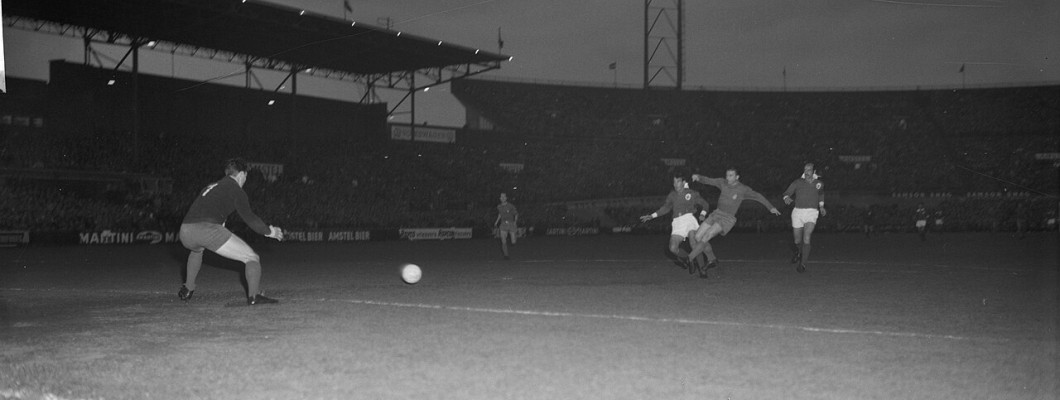
1962 · Amsterdam: Benfica – Real Madrid 5-3
On 2 May 1962, at the Olympisch Stadion, Puskás scored a first-half hat-trick and Real went in 3-2 up. After the break Coluna equalised and a 20-year-old from Mozambique, Eusébio, sealed a 5-3 win with two thunderbolts, one from the penalty spot.
At the end Puskás symbolically handed his shirt to Eusébio, as if passing on the torch. Guttmann left soon after, and legend has it that he cursed Benfica never to win a European title again.
1963 · London: Milan – Benfica 2-1
The first final on English soil was played on 22 May 1963 at Wembley, which was less than half full. Eusébio opened the scoring, but Brazilian-born Altafini, who had played at World Cups for both Brazil and Italy, turned the game with two goals.
Nereo Rocco's Milan did not wear their red and black stripes but a white change kit, which became known as their "lucky" European shirt. It was the first final without a Spanish club.
1964 · Vienna: Inter – Real Madrid 3-1
At the Prater on 27 May 1964, Helenio Herrera's Inter reached the final at their first attempt. Sandro Mazzola scored twice and Milani once, while Felo replied for Real.
Tagnin man-marked Di Stéfano all game, and goalkeeper Sarti played despite getting hurt in the warm-up. It was Di Stéfano's last official match in the white shirt.
1965 · Milan: Inter – Benfica 1-0
On 27 May 1965 the final was played at Inter's own San Siro, before 89,000 fans and on a pitch soaked by rain. Brazilian Jair hit a low shot just before half-time and the ball slipped under Costa Pereira.
Pereira was later injured and, since there were no substitutes, defender Germano went in goal. With ten men Benfica could not equalise and Inter kept their title.
1966 · Brussels: Real Madrid – Partizan 2-1
At the Heysel on 11 May 1966, Partizan became the first Eastern European team to reach a final and went ahead through Velibor Vasović. Amancio and Serena turned it around within six minutes.
It was the first Real side to win the trophy with only Spanish players, and captain Gento collected his sixth cup. After the win four players posed for Marca as the Beatles, and the team became known as the "Yé-yé", after "She Loves You".
1967 · Lisbon: Celtic – Inter 2-1
At the Estádio Nacional on 25 May 1967, Inter took an early lead with a Mazzola penalty and retreated into catenaccio. Jock Stein's Celtic attacked relentlessly, Gemmell equalised with a thunderbolt and Chalmers won it late on.
All of the "Lisbon Lions" had been born within 30 miles of Glasgow. They wore the green and white hoops with the numbers on their shorts rather than on their backs, something Celtic kept for decades. Because of the pitch invasion, captain Billy McNeill received the trophy in the stand.
1968 · London: Manchester United – Benfica 4-1 (a.e.t.)
Ten years after Munich, on 29 May 1968, Manchester United took to the Wembley pitch in blue. Bobby Charlton, a survivor of the disaster like Foulkes, scored with a rare header, but Jaime Graça equalised and Stepney kept his side alive with a big save from Eusébio.
In extra time George Best rounded the goalkeeper and rolled in the 2-1 into an empty net. Brian Kidd scored on his 19th birthday and Charlton made it 4-1.
1969 · Madrid: Milan – Ajax 4-1
On 28 May 1969, at the Bernabéu, the Ajax of a young Johan Cruyff became the first Dutch team in a final. But Milan were unstoppable: Pierino Prati scored a hat-trick and Sormani added another.
Ajax's goal came from a Vasović penalty, the same man who had scored for Partizan in 1966. Prati's hat-trick stood for more than half a century as the last in a final of the competition.
The decade's legacy
The decade closed the chapter of Real's total dominance and opened the way for the Portuguese, the Italians and the British. The shirts stayed with it: the white of Real and Milan, the red of Benfica, Celtic's hoops and United's blue.
There is a Greek sequel too. The Ajax side that lost in 1969 returned to Wembley two years later, the venue of the 1963 and 1968 finals, and beat Panathinaikos in the 1971 final.
See our Champions League club jerseys at sportarena.gr.
Photo: Puskás's first goal in the 1962 Benfica – Real Madrid final in Amsterdam – Joop van Bilsen / Anefo (Nationaal Archief), Wikimedia Commons, licensed under CC0.