
The idea came from a newspaper office in Paris. Gabriel Hanot and Jacques Ferran of L'Équipe revived the plan for a tournament of Europe's champions in late 1954, and in 1955 the European Cup was born, the forerunner of today's Champions League. In the first four finals, from 1956 to 1959, one colour dominated: the all-white of Real Madrid.
1956 · Paris: Real Madrid – Reims 4-3
The first final was played on 13 June 1956 at the Parc des Princes, in front of about 38,000 spectators. France's Reims, "the red and whites" of Champagne, had come through unbeaten, knocking out Hibernian in the semi-finals, while Real had got past Milan. The referee was England's Arthur Ellis, and Reims, without their best defender Armand Penverne, went 2-0 up inside ten minutes through Leblond and Templin.
Alfredo Di Stéfano and Héctor Rial levelled before half-time. Michel Hidalgo put Reims ahead again from a Raymond Kopa free-kick, but Marquitos and Rial once more made it 4-3. Captain Miguel Muñoz lifted the trophy.
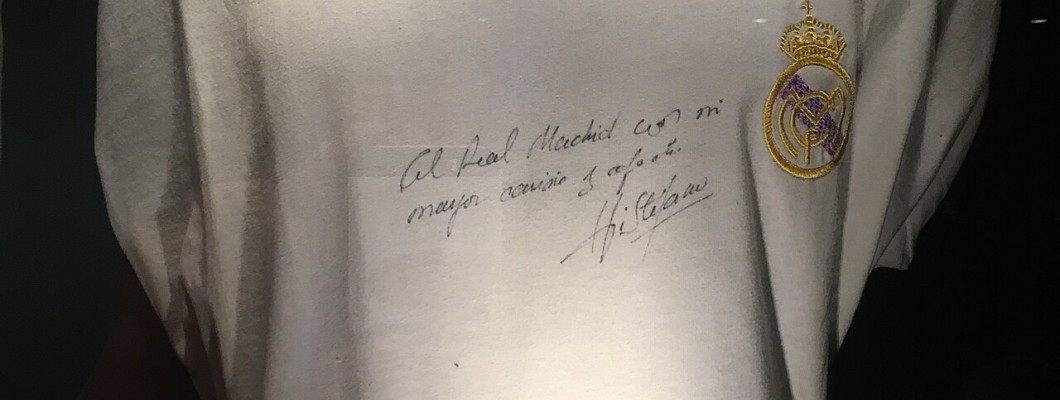
Kopa left as a loser, but soon afterwards he moved to Real, and years later he admitted he was lucky Madrid had won, since that meant his new club would be back in the competition as holders. A shirt that, according to its description on Wikimedia Commons, Di Stéfano wore that night still survives: white, simple, with the crest on the chest.
1957 · Madrid: Real Madrid – Fiorentina 2-0
On 30 May 1957 the final was played at Real's own ground, the Santiago Bernabéu, before 124,000 people. It was the first time the winner celebrated at home, and the first time an Italian side, purple-clad Fiorentina, got that far.
Kick-off was brought forward because the Florentines were not used to playing under floodlights. The deadlock was broken by a disputed penalty: Dutch referee Leo Horn ignored an offside flag against Mateos and gave a penalty for a foul that, by most accounts, happened just outside the box. Di Stéfano converted and Gento made it 2-0 on the break, one on one with a young Giuliano Sarti.
Real became the first team to successfully defend the trophy. Kopa was now in their ranks, while Sarti would a few years later become the goalkeeper of the great Inter side.
1958 · Brussels: Real Madrid – Milan 3-2 (a.e.t.)
At the Heysel on 28 May 1958, Real faced the red and black of Milan. The season had been scarred by the Munich air disaster, in which eight Manchester United players were killed, Duncan Edwards among them. Milan knocked out the stricken Red Devils in the semi-finals, while Real had thrashed Antwerp 6-0 and Sevilla 8-0 on their way.
The Italians, with Uruguayan Schiaffino and Argentine Grillo, led twice. Di Stéfano and Rial replied, and for the first time a final went to extra time. There, in the 107th minute, Gento scored with a deflected shot to give Real a third title in a row.
The match showed something that would become the rule: the great clubs of the era fielded stars from all over the world. Argentine-born Di Stéfano had taken Spanish citizenship in 1956, and Uruguayan Santamaría played in Real's defence. Even Milan had started their run the hard way, needing a play-off in Zurich to get past Rapid Wien.
1959 · Stuttgart: Real Madrid – Reims 2-0
On 3 June 1959, at the Neckarstadion before 72,000 fans, the first final was replayed. Real had needed a play-off in Zaragoza to get past Atlético in the semi-finals, while Reims were unbeaten until the final. This time, though, Kopa wore white and his opponents were his old club.
Mateos scored almost from the kick-off and Di Stéfano made it 2-0 just after half-time. Reims, with Just Fontaine up front, the player whose arrival along with other signings had helped deliver the 1958 double, had no answer. Their goalkeeper Dominique Colonna later said their bad luck was to exist at the same time as that Real side.
The final, refereed by West German Albert Dusch, gave Real a fourth straight title. On the road to Stuttgart they had knocked out Beşiktaş and Wiener SK, and the white shirt, with no sponsor and a simple collar, had by now become the most recognisable garment in European football.
The decade's legacy
Four finals, four Real wins, and Di Stéfano on the scoresheet in every one. Around him Gento, Rial, Kopa and Santamaría built Europe's first great 'super team'. The team would make it five out of five in Glasgow in 1960, with Di Stéfano scoring again, and its all-white kit has been a byword for European success ever since.
The decade left something else too: the idea that a shirt can become a legend. The red and white of Reims, the purple of Fiorentina and the stripes of Milan also wrote the first pages of the greatest club competition. And Kopa, who switched sides, later returned to Reims and led them to the 1960 league title.
See our Champions League club jerseys at sportarena.gr.
Photo: Real Madrid's shirt from the 1956 final – TheTank, Wikimedia Commons, licensed under CC BY-SA 4.0.