
On 25 May 1983, at the "Spyros Louis" Olympic Stadium in Marousi, Hamburger SV beat Juventus 1-0 and won the European Cup. On 25 May 2027 it will be 44 years since that night. It was the first final of the competition hosted by Athens.
The road also went through Piraeus
Ernst Happel's Hamburg had a tough draw. They knocked out Dynamo Berlin and in the second round faced Olympiacos: 1-0 in Hamburg and a heavy 4-0 in Piraeus. Then came Dynamo Kyiv, with a 3-0 in Kyiv, and Real Sociedad in the semi-final.
Giovanni Trapattoni's Juventus went past Hvidovre, Standard Liège, Aston Villa and Widzew Łódź. At Villa Park Paolo Rossi headed in after just 38 seconds, and the Italian had scored in every round.
The "super team" and the underdogs
On paper, Juventus were unbeatable. Their line-up included six 1982 world champions, Zoff, Gentile, Cabrini, Scirea, Tardelli and Rossi, and alongside them Michel Platini and Zbigniew Boniek.
Hamburg, the German champions, had lost the 1980 final to Nottingham Forest and were clear underdogs. Felix Magath himself later spoke of facing a "super team".
OAKA was brand new: it had been inaugurated by Konstantinos Karamanlis on 8 September 1982, less than a year earlier. The final was its first big European test.
About 73,500 spectators were in the stands, around 40,000 of them Juventus fans. During the warm-up, captain Horst Hrubesch ran up to the VIP stand to ask where he would collect the cup.
Red against the black-and-white stripes
Juventus wore their classic black-and-white vertical stripes with white shorts. Hamburg, who usually play in white shirts, appeared all in red, with adidas' white stripes on the shoulders.
The red shirt of Athens stayed in HSV fans' memory as the shirt of the greatest triumph in the club's history.
The match: one shot in the 9th minute
Juventus started well, with a header by Roberto Bettega. In the 9th minute, however, Magath picked up the ball at the corner of the box and sent a left-foot shot into the top corner past Dino Zoff. Years later, watching the goal again in a documentary, Magath remarked that the legendary Italian simply could not have stopped it.
From then on Hamburg defended with discipline and looked for the counter. Platini found no space against his man-marker and claimed a penalty after a collision with goalkeeper Uli Stein. Stein made important saves, among them one from a Cabrini volley just before half-time.
In the 56th minute Trapattoni took off Rossi for Domenico Marocchino, but the change did not change the picture. Hamburg even had chances for a second goal at the end.
The heroes of OAKA
Happel's eleven were Stein, Kaltz, Hieronymus, Jakobs, Wehmeyer, Groh, Rolff, Magath, Milewski, Hrubesch and Bastrup, with Thomas von Heesen coming on for Bastrup. Magath had also scored in the 1977 Cup Winners' Cup final, which Hamburg also won.
Captain Hrubesch summed up the team's mentality by saying that after such a long road, there is no point losing the final. Happel, for his part, neutralised one of the strongest attacking sides in Europe.
Why it went down in history
For Hamburg it was the greatest triumph in their history, accompanied by the retention of the Bundesliga title. The final ended a six-year run of English European champions and was the sixth consecutive final to finish 1-0.
For Athens it was OAKA's first great European night; the stadium later hosted finals of the competition again in 1994 and 2007. For Juventus the disappointment was huge: La Stampa accused their attack of lacking both pace and strength. The "Old Lady" would finally win her first cup two years later, in 1985.
See our Champions League club jerseys at sportarena.gr.
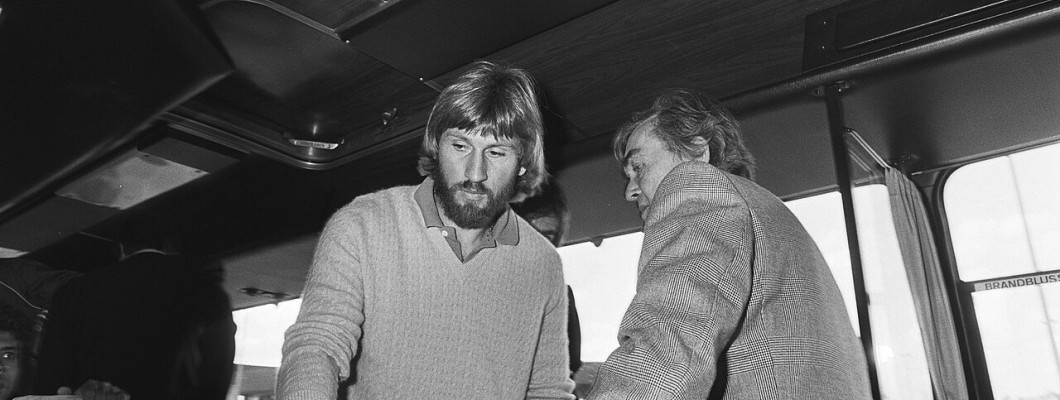
Photo: Ernst Happel with Manfred Kaltz (left) at Schiphol airport – Marcel Antonisse / Anefo, Nationaal Archief, Wikimedia Commons, licensed under CC0.