
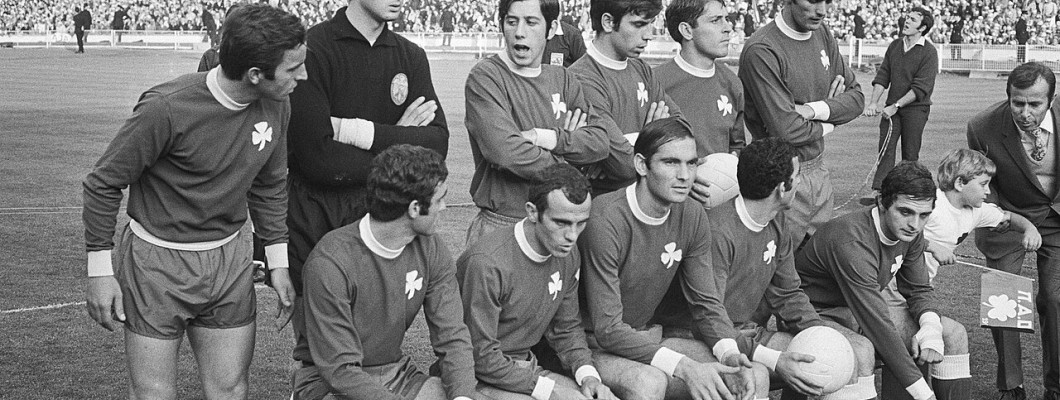
On 2 June 1971, at Wembley in London, Panathinaikos played in the European Cup final against Ajax and lost 2-0. On 2 June 2027 it will be 56 years since that night. To this day it is the only time a Greek team has reached the final of the competition.
Puskás and a team of amateurs
In 1970 the Panathinaikos bench was taken over by Ferenc Puskás, the Hungarian legend who had scored four goals in the 1960 final. His players were amateurs: centre-forward Antonis Antoniadis, for example, worked for an insurance company. Puskás made no big speeches in the dressing room, but he told them that their opponents also had only two legs.
The road began with Luxembourg's Jeunesse Esch (7-1 on aggregate) and Slovan Bratislava (4-2). In the quarter-finals Panathinaikos drew 1-1 at Goodison Park and 0-0 in Athens with Everton, going through on the away goal.
The comeback against Red Star
The semi-final brought the great miracle. In Belgrade, in front of about 90,000 spectators, Red Star won 4-1 and everyone considered the tie over.
On 28 April, at a packed Leoforos, Antoniadis scored in the first minute and again in the 55th. In the 63rd minute Aristidis Kamaras made it 3-0, sending the team to London. Athens celebrated for hours, with the stands covered in green flags and banners.
Ajax, for their part, went past 17 Nëntori Tirana, Basel, Celtic and Atlético Madrid. They had lost the 1969 final and now wanted their first cup.
Green shamrock against the red band
Panathinaikos wore the green shirt with the white shamrock on the chest. Ajax appeared in the white shirt with the broad red vertical band and white shorts.
The Ajax shirt of those years, in which they won three European Cups in a row from 1971 to 1973, has been voted the most legendary football shirt. For every Greek fan, Panathinaikos' green is simply the Wembley shirt.
The match: one goal early, one at the end
More than 83,000 spectators were in the stadium, with Englishman Jack Taylor refereeing. Panathinaikos had secured around 32,800 tickets, far fewer than their fans wanted.
Rinus Michels' Ajax took the lead as early as the 5th minute through Dick van Dijk. Panathinaikos held on with passion and with the saves of Takis Oikonomopoulos, while Johan Cruyff and Johan Neeskens stood out for the Dutch.
In the 87th minute Arie Haan, who had come on at half-time, shot and the ball deflected off Anthimos Kapsis for 2-0. That is why some sources record the goal as an own goal.
The heroes of Wembley
Puskás' eleven were Oikonomopoulos, Tomaras, Kapsis, Sourpis, Vlachos, Kamaras, Eleftherakis, Grammos, Antoniadis, Domazos and Filakouris. Mimis Domazos, "the General", was the soul of the team. Antoniadis finished as the competition's top scorer, with ten goals.
A special place in the fans' memory also belongs to centre-back Fragiskos Sourpis, a doctor by profession, whose name even made it into a popular song. In 2014 the City of Athens honoured the team with an exhibition on Wembley and Puskás, and a commemorative plaque was unveiled at the club's ground.
Why it went down in history
For Ajax it was the start of a dynasty of three trophies in a row. For Panathinaikos it was the high point in the history of Greek club football. Even Puskás is considered to have achieved here the greatest success of his coaching career.
The story had a sequel. Ajax refused to play Nacional of Montevideo in the Intercontinental Cup and Panathinaikos took their place: 1-1 at the Karaiskakis, with a goal by Filakouris, and a 2-1 defeat in Montevideo. In that tie Giannis Tomaras suffered a serious injury that effectively marked the rest of his career.
In 2000, for Ajax's centenary, the veterans of the two teams met again in Amsterdam. There Domazos scored and Panathinaikos earned a small, symbolic "revenge".
See our Champions League club jerseys at sportarena.gr.
Photo: The Panathinaikos team at Wembley, 2 June 1971 – Anefo, Nationaal Archief, Wikimedia Commons, licensed under CC0.