Our site uses cookies in order for you to have the best experience! You are able to change your cookies preferences at any time by choosing the "Cookies Policy" link at the bottom of every page.
Cookies Policy On this page we provide details on what cookies, web beacons and similar technologies are, what information we collect through them and how we use them to improve your experience. This page was designed to help you understand more about these technologies and their use by us as well as reviewing your prior consent or not in connection with the opt-in, opt-in -out).
What are cookies? Like most sites, staff-jeans.com uses cookies, web beacons, and similar technologies. These are small data files that are placed on your computer, mobile, tablet, or other devices, and allow us to collect specific pieces of information when you visit or interact with our site or our services. The names and types of cookies, web beacons, and similar technologies we use to collect information (such as on the pages you visit, click links, or other actions you make on our services or on our ads and on our emails ) may sometimes change. To help you better understand this policy and use of such technology from us, we provide you with the following definitions:
Cookies: These are small text files (usually composed of letters and numbers) that are placed in your browser or device memory when you visit a site or see a message. There are several types of cookies such as: Session cookies: These are necessary for the smooth operation of the site and expire when you close your browser. They allow us to link your actions when you go from link to link within our site. Persistent cookies: Stored on your device for a certain amount of time. First-party cookies: They are placed by the site you are visiting. Third-party cookies: They are placed through the site you visit on behalf of another site.
You can generally manage or disable cookies using tools available to all major browsers. For each browser you use, you'll need to set up your cookie options for everyone. Each browser may have different tools available to handle it.
Web beacons: These are small graphic pictures (also known as "pixel tags" or "clear GIFS") that may be included in our site or in some emails or generally in our services and which work in conjunction with cookies to identify the user or some behavior.
Similar technologies: They are technologies that store information in your browser or device such as Flash cookies, HTML 5 cookies and others provided by the various web application programming methods. These technologies can work independently for all Browsers you use and may need to be set up directly through your installed applications or your device. We do not use such technologies to store data.
We use the term cookies or similar technologies in our policies to refer to all the technologies we use to store data in your browser or device or to collect data that helps us recognize you as described above.
Service Providers In addition to our first party cookies, we are still working with Service Providers who are companies that help us in various aspects of our business such as services, applications, or advertising tools. With regard to ads, we use certified service providers to help provide you with relevant advertisements for our products at various points of the internet. These service providers may also place cookies on your device (third party cookies). They can also collect information to help them identify your device such as your IP address or other unique features.
What options do you have? We provide various services on our site that are only available with the use of these technologies. You can always block, turn off or turn off these technologies in your browser if it allows. However, in this case, you will not be able to take advantage of some features of our site. You may also need to enter if you are a registered user, your username and your password more often. For more information, please see your browser or device settings. For any personal information collected and stored by our site through these technologies, we have first obtained the explicit consent of the user and after having informed the user in detail as far as possible about its use by us as well as giving the user ability to disable these technologies through the window that appears at the bottom of all pages when it first enters the site or at any time at the bottom of this page.
The use we make about these technologies belongs to the following general categories:
Operational Cookies (required). We use cookies that are necessary for the operation of our site. These include technologies that allow you to access pages on our site which must necessarily identify which user you are like a basket page, order page or similar features as well as features such as saving the language in which you chose to view our site , storing the currency that by default is the euro for use in the case of credit card payment, saving your choice whether or not to have cookies on your browser or device and cookies or similar technologies that provide security against abusive use of the site or attempted fraud. These cookies are not disabled if you choose not to use cookies when you enter the site or at the bottom of this page. However, they may be disabled by your browser or device settings, but disabling them may cause the site to malfunction.
Analytics cookies (Performance-Related). We use first party and third party cookies, web beacons, and other technologies to store statistics about the user's behavior on our site or services (such as where our site found, which pages we visited, what newsletter we opened, etc.) in order to improve our services to the visitor either by correcting functional problems on our pages or by making our pages better in terms of their use by offering a better user experience or by updating our commercial strategy RH based on your preferences in order to provide you the products you want possible.
Advertising and remarketing cookies. We use third party cookies (such as facebook and google cookies) to provide you with the content you saw on our site with advertisements, offers and opportunities for our products in the above and other platforms and their affiliates.
We offer you the ability to activate or disable all cookies used on this site other than the cookies when you first enter our site. At any time at the end of this page, you can change the activation setting or not of the cookies you previously selected. If you choose to disable cookies while you previously opted to enable them, third party cookies will stop recording information about you, however you may still see our ads that are not so relevant to you because of we can only deactivate further recording from the moment you selected it to be deactivated. To manage or disable third party cookies permanently, see below.
Use of cookies by authorized third parties We work with third parties known as "Service Providers" who are authorized by us to place third party cookies, web beacons and other technologies on our site. These providers help us to improve our services either through the statistics we collect or through the targeted by the interests of our site's ad users. These providers are subject to confidential agreements with us as well as other legal obligations to collect or use personal data on their part.
Since you have accepted the use of cookies, third party cookies and similar technologies were probably placed by the following service providers Facebook: In order to provide you with advertisements through Facebook's advertising and marketing platforms (such as Audience Network, Website Custom Audiences) and other Facebook plugin or marketing tools. Google: For statistical purposes through the google analytics platform, as well as advertising and marketing reasons through its tools (such as DoubleClick for Publishers, Google DoubleClick AdX Service, Adwords). Skroutz.gr: Our company uses the Skroutz Analytics service, which operates with cookies, in order to continually evaluate and improve the quality of services it provides to the consumer. Through this service, if you have previously given your consent through Skroutz.gr, anonymous usage statistics are securely disclosed to us by Skroutz. The data obtained from our company through this service is covered by Skroutz.gr's privacy policy and cookies policy, where you may also withdraw your consent. Pushcrew notifications: For marketing and marketing purposes. Tawk to chat platform: For statistical purposes and to help the chat user on which page the user they are chatting with and similar auxiliary uses. The above providers may use personal data collected through their cookies on our site in accordance with their own privacy terms Facebook Data Policy: https://www.facebook.com/privacy/explanation Google Privacy Policy: https://www.google.com/intl/en/policies/privacy/). Terms of use Scrooge: https://www.skroutz.gr/privacy Pushcrew notifications: https://pushcrew.com/privacy-policy/gdpr-security-compliance/ Tawk's Privacy Policy: https://www.tawk.to/privacy-policy/
Keep in mind that cookies are placed on the browser. If you sign in to our site from different devices and choose to use cookies in some of them, then you may still choose not to use cookies, see our ads on the platforms of some of our partners above on any of your devices.
Except for authorized service providers, we do not allow any third party to place cookies or similar technologies on our site for the purpose of detecting or collecting personal data.
You can accept or disable the placement of cookies from our site by clicking on the following button: Your consent or does not take 365 days from the moment you click the button. If at the end of the 365 you visit our site, you will be consulted again or not.
Borussia Dortmund: the club born in defiance of a priest that turned yellow and black
19 Dec
Posted Bynikos0 Comment(s)8 View(s)
Borussia Dortmund was born out of a small rebellion. On 19 December 1909, in a pub on the north side of Dortmund, a group of young men decided to play football without asking anyone's permission. 117 years have passed since that evening, and the team that started out in blue and white stripes is now synonymous with yellow and black.
The "Zum Wildschütz" pub
The founders were members of the youth group of the Catholic Holy Trinity parish. The priest in charge, Hubert Dewald, frowned on their football ambitions and tried to stop the founding. The meeting took place at the "Zum Wildschütz" restaurant on Oesterholzstraße, near today's Borsigplatz. Of the more than forty who gathered, eighteen finally stuck to the plan. Their spokesman was Franz Jacobi, who had been playing with his friends since 1906 on a pitch known as the "Weiße Wiese".
A name from a beer sign
Borussia is the Latin name for Prussia, but in Dortmund the choice had a more down-to-earth origin. According to the story told by the club itself, Jacobi looked at an enamel advertisement for the local Borussia brewery on the wall and, with no better suggestion on the table, the name stuck. That is how Ballspielverein Borussia 1909 came about, known to everyone as BVB. The first official match took place on 15 January 1911 at the "Weiße Wiese" and ended in a 9-3 win over VfB Dortmund.
From blue and white to lemon yellow
The first shirt looked nothing like today's. The players wore blue and white stripes with a red diagonal sash and black shorts. In 1912–13 three neighbouring clubs, Rhenania, Britannia and Deutsche Flagge, dissolved and their members moved to Borussia. Along with the new players came new colours: the team switched to a yellow, almost lemon shirt with black shorts. The crest with BVB and the year 09 appeared a little later, in 1918–19. These colours also gave the club its nickname Die Schwarzgelben, the Black and Yellows.
Glasgow 1966: a first for Germany
Dortmund won their first German championships in 1956, 1957 and 1963. The biggest moment of that era, however, came abroad. On 5 May 1966, at Hampden Park in Glasgow, they beat Liverpool 2-1 after extra time in the Cup Winners' Cup final, with goals from Sigfried Held and Reinhard Libuda. It was the first European trophy ever won by a German club.
Munich 1997 and Ricken's lob
The mid-1990s brought back-to-back league titles in 1995 and 1996 and a run of Nike shirts in a bright, almost neon yellow. On 28 May 1997, at Munich's Olympic Stadium, Dortmund faced holders Juventus. Karl-Heinz Riedle scored twice and, after Del Piero pulled one back, substitute Lars Ricken sealed a 3-1 win with a long-range lob just 16 seconds after coming on. A few months later the Intercontinental Cup followed, with a 2-0 win over Cruzeiro.
The Yellow Wall and the rebirth
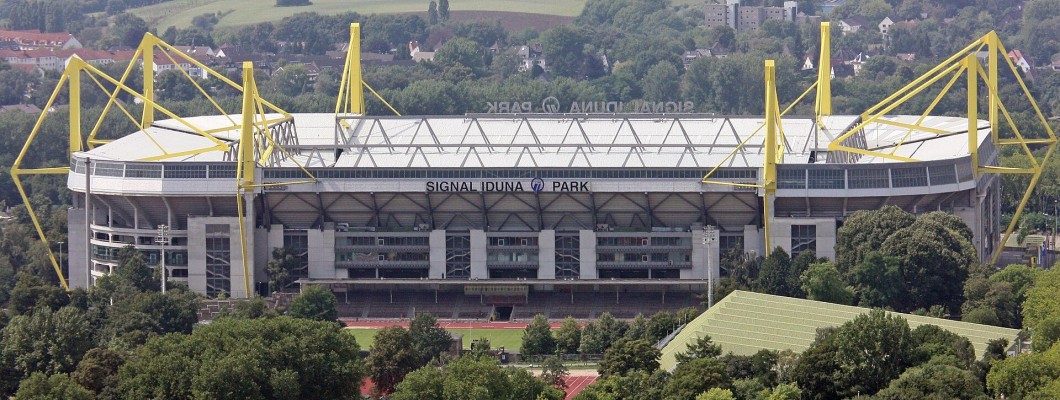
Since 1974 the team's home has been the Westfalenstadion, built for that year's World Cup next to the old Stadion Rote Erde. Its south stand, the Gelbe Wand, is considered the largest standing terrace in Europe. In 2005 the club came close to bankruptcy, but recovered. With Jürgen Klopp on the bench it won the 2011 league title and the 2012 double, and it reached Champions League finals in 2013 and 2024. Since 2012 the shirts have been made by Puma.
So happy birthday to the club that was born out of a quarrel with the parish priest. May the Yellow Wall always be full and the shirts always visible from a mile away.
See Borussia Dortmund shirts and merchandise at sportarena.gr.