Our site uses cookies in order for you to have the best experience! You are able to change your cookies preferences at any time by choosing the "Cookies Policy" link at the bottom of every page.
Cookies Policy On this page we provide details on what cookies, web beacons and similar technologies are, what information we collect through them and how we use them to improve your experience. This page was designed to help you understand more about these technologies and their use by us as well as reviewing your prior consent or not in connection with the opt-in, opt-in -out).
What are cookies? Like most sites, staff-jeans.com uses cookies, web beacons, and similar technologies. These are small data files that are placed on your computer, mobile, tablet, or other devices, and allow us to collect specific pieces of information when you visit or interact with our site or our services. The names and types of cookies, web beacons, and similar technologies we use to collect information (such as on the pages you visit, click links, or other actions you make on our services or on our ads and on our emails ) may sometimes change. To help you better understand this policy and use of such technology from us, we provide you with the following definitions:
Cookies: These are small text files (usually composed of letters and numbers) that are placed in your browser or device memory when you visit a site or see a message. There are several types of cookies such as: Session cookies: These are necessary for the smooth operation of the site and expire when you close your browser. They allow us to link your actions when you go from link to link within our site. Persistent cookies: Stored on your device for a certain amount of time. First-party cookies: They are placed by the site you are visiting. Third-party cookies: They are placed through the site you visit on behalf of another site.
You can generally manage or disable cookies using tools available to all major browsers. For each browser you use, you'll need to set up your cookie options for everyone. Each browser may have different tools available to handle it.
Web beacons: These are small graphic pictures (also known as "pixel tags" or "clear GIFS") that may be included in our site or in some emails or generally in our services and which work in conjunction with cookies to identify the user or some behavior.
Similar technologies: They are technologies that store information in your browser or device such as Flash cookies, HTML 5 cookies and others provided by the various web application programming methods. These technologies can work independently for all Browsers you use and may need to be set up directly through your installed applications or your device. We do not use such technologies to store data.
We use the term cookies or similar technologies in our policies to refer to all the technologies we use to store data in your browser or device or to collect data that helps us recognize you as described above.
Service Providers In addition to our first party cookies, we are still working with Service Providers who are companies that help us in various aspects of our business such as services, applications, or advertising tools. With regard to ads, we use certified service providers to help provide you with relevant advertisements for our products at various points of the internet. These service providers may also place cookies on your device (third party cookies). They can also collect information to help them identify your device such as your IP address or other unique features.
What options do you have? We provide various services on our site that are only available with the use of these technologies. You can always block, turn off or turn off these technologies in your browser if it allows. However, in this case, you will not be able to take advantage of some features of our site. You may also need to enter if you are a registered user, your username and your password more often. For more information, please see your browser or device settings. For any personal information collected and stored by our site through these technologies, we have first obtained the explicit consent of the user and after having informed the user in detail as far as possible about its use by us as well as giving the user ability to disable these technologies through the window that appears at the bottom of all pages when it first enters the site or at any time at the bottom of this page.
The use we make about these technologies belongs to the following general categories:
Operational Cookies (required). We use cookies that are necessary for the operation of our site. These include technologies that allow you to access pages on our site which must necessarily identify which user you are like a basket page, order page or similar features as well as features such as saving the language in which you chose to view our site , storing the currency that by default is the euro for use in the case of credit card payment, saving your choice whether or not to have cookies on your browser or device and cookies or similar technologies that provide security against abusive use of the site or attempted fraud. These cookies are not disabled if you choose not to use cookies when you enter the site or at the bottom of this page. However, they may be disabled by your browser or device settings, but disabling them may cause the site to malfunction.
Analytics cookies (Performance-Related). We use first party and third party cookies, web beacons, and other technologies to store statistics about the user's behavior on our site or services (such as where our site found, which pages we visited, what newsletter we opened, etc.) in order to improve our services to the visitor either by correcting functional problems on our pages or by making our pages better in terms of their use by offering a better user experience or by updating our commercial strategy RH based on your preferences in order to provide you the products you want possible.
Advertising and remarketing cookies. We use third party cookies (such as facebook and google cookies) to provide you with the content you saw on our site with advertisements, offers and opportunities for our products in the above and other platforms and their affiliates.
We offer you the ability to activate or disable all cookies used on this site other than the cookies when you first enter our site. At any time at the end of this page, you can change the activation setting or not of the cookies you previously selected. If you choose to disable cookies while you previously opted to enable them, third party cookies will stop recording information about you, however you may still see our ads that are not so relevant to you because of we can only deactivate further recording from the moment you selected it to be deactivated. To manage or disable third party cookies permanently, see below.
Use of cookies by authorized third parties We work with third parties known as "Service Providers" who are authorized by us to place third party cookies, web beacons and other technologies on our site. These providers help us to improve our services either through the statistics we collect or through the targeted by the interests of our site's ad users. These providers are subject to confidential agreements with us as well as other legal obligations to collect or use personal data on their part.
Since you have accepted the use of cookies, third party cookies and similar technologies were probably placed by the following service providers Facebook: In order to provide you with advertisements through Facebook's advertising and marketing platforms (such as Audience Network, Website Custom Audiences) and other Facebook plugin or marketing tools. Google: For statistical purposes through the google analytics platform, as well as advertising and marketing reasons through its tools (such as DoubleClick for Publishers, Google DoubleClick AdX Service, Adwords). Skroutz.gr: Our company uses the Skroutz Analytics service, which operates with cookies, in order to continually evaluate and improve the quality of services it provides to the consumer. Through this service, if you have previously given your consent through Skroutz.gr, anonymous usage statistics are securely disclosed to us by Skroutz. The data obtained from our company through this service is covered by Skroutz.gr's privacy policy and cookies policy, where you may also withdraw your consent. Pushcrew notifications: For marketing and marketing purposes. Tawk to chat platform: For statistical purposes and to help the chat user on which page the user they are chatting with and similar auxiliary uses. The above providers may use personal data collected through their cookies on our site in accordance with their own privacy terms Facebook Data Policy: https://www.facebook.com/privacy/explanation Google Privacy Policy: https://www.google.com/intl/en/policies/privacy/). Terms of use Scrooge: https://www.skroutz.gr/privacy Pushcrew notifications: https://pushcrew.com/privacy-policy/gdpr-security-compliance/ Tawk's Privacy Policy: https://www.tawk.to/privacy-policy/
Keep in mind that cookies are placed on the browser. If you sign in to our site from different devices and choose to use cookies in some of them, then you may still choose not to use cookies, see our ads on the platforms of some of our partners above on any of your devices.
Except for authorized service providers, we do not allow any third party to place cookies or similar technologies on our site for the purpose of detecting or collecting personal data.
You can accept or disable the placement of cookies from our site by clicking on the following button: Your consent or does not take 365 days from the moment you click the button. If at the end of the 365 you visit our site, you will be consulted again or not.
It all started with a small advertisement in a local newspaper. A few days later, on 15 November 1893, FC Basel was founded, the club the whole of Switzerland now knows as FCB or "RotBlau". This year the team from the banks of the Rhine turns 133. In that time it has collected 21 league titles and caused trouble for several of Europe's biggest clubs. Its shirt, half red and half blue, is one of the most distinctive on the continent.
An advert in the newspaper
On 12 November 1893 Roland Geldner placed a notice in the Basler National newspaper, asking anyone who wanted to play football to gather. The meeting was set for the following Wednesday at 8:15 in the evening, at the Schuhmachern-Zunft restaurant. Eleven men turned up, most of them from the academic world, and Geldner became the first president. The first official match took place on 10 December against a team from a school gymnastics club, and Basel won 2-0.
Red for love, blue for loyalty
The club's colours were red and blue from the very first day. The most common explanation is that some of the founding members belonged to the Basler Ruder-Club, a rowing club with the same colours. That is also where the nickname "RotBlau", meaning "RedBlue", comes from. Fans also call the team "Bebbi", which in the local dialect means "citizen of Basel". The shirt even carries a Swiss German phrase, "Rot isch unseri Liebi…", which roughly says that red is their love, blue their eternal loyalty and Basel their city.
A badge in the middle of the chest
The crest is a shield with a gold outline, red on the left and blue on the right, with the gold letters FCB in the centre. One special feature: Basel do not wear it on the left, like most teams, but in the middle of the shirt. Nike and adidas have both made the shirt, adidas from 2012 to 2017. Since 2025 the manufacturer has been Macron, as on the Macron goalkeeper shirt we have in our shop, while the main sponsor is Novartis.
Benthaus, Odermatt and Hügi
The club's first great era came with coach Helmut Benthaus, who stayed on the bench from 1965 to 1982 and brought several league titles. The leader on the pitch was Karl Odermatt, with 411 appearances in all competitions between 1963 and 1976. The list of greats also includes Josef Hügi, the club's all-time top scorer in the league. Those years also produced one of the strangest cup finals ever. In 1967 the Lausanne players sat down on the pitch after Basel scored, the referee abandoned the match and the trophy was awarded to Basel with a 3-0 win on paper.
From the Landhof to the "Joggeli"
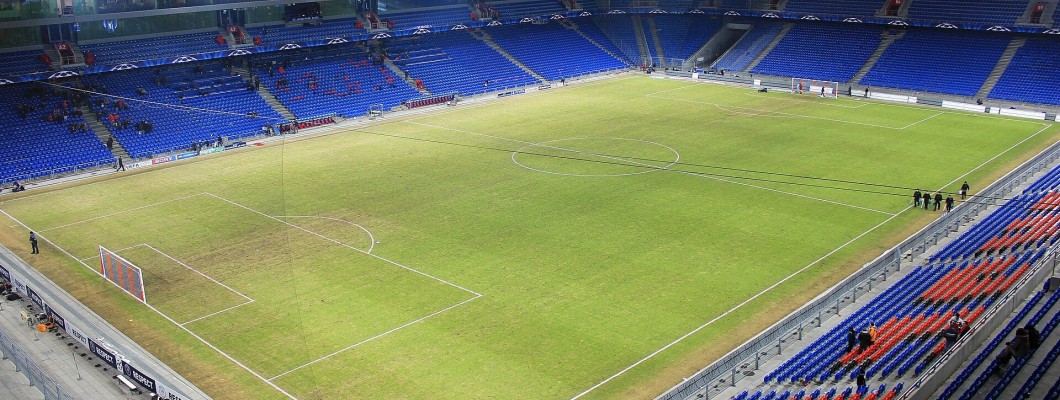
The club's first home was the Landhof, which its owner made available free of charge in the early years. On 15 March 2001St. Jakob-Park opened on the site of the old St. Jakob Stadium, with a capacity of over 37,000. Locals affectionately call it the "Joggeli". It hosted six Euro 2008 matches and the 2016 Europa League final.
European nights
In the Champions League, on 7 December 2011, they beat Manchester United 2-1 and knocked them out of the competition, and a few months later they beat Bayern 1-0 in the first leg of the last 16. In 2013 they reached the Europa League semi-finals after eliminating Tottenham on penalties, and the following season they beat Chelsea 2-1 in London.
The comeback double
After a period without titles, the 2024-25 season brought a return to the top. With Fabio Celestini as coach and Xherdan Shaqiri, who came back to the club in the summer of 2024, Basel won their 21st league title, the first since 2017. Shortly afterwards they also lifted their 14th Swiss Cup, beating Biel 4-1 in the final, for the seventh double in the club's history.
From a newspaper advert to the packed stands of St. Jakob-Park, Basel have stayed loyal to their two colours. Happy birthday to "RotBlau", and for chilly November evenings there is always the Macron sweatshirt!
See FC Basel shirts and merchandise at sportarena.gr.