Our site uses cookies in order for you to have the best experience! You are able to change your cookies preferences at any time by choosing the "Cookies Policy" link at the bottom of every page.
Cookies Policy On this page we provide details on what cookies, web beacons and similar technologies are, what information we collect through them and how we use them to improve your experience. This page was designed to help you understand more about these technologies and their use by us as well as reviewing your prior consent or not in connection with the opt-in, opt-in -out).
What are cookies? Like most sites, staff-jeans.com uses cookies, web beacons, and similar technologies. These are small data files that are placed on your computer, mobile, tablet, or other devices, and allow us to collect specific pieces of information when you visit or interact with our site or our services. The names and types of cookies, web beacons, and similar technologies we use to collect information (such as on the pages you visit, click links, or other actions you make on our services or on our ads and on our emails ) may sometimes change. To help you better understand this policy and use of such technology from us, we provide you with the following definitions:
Cookies: These are small text files (usually composed of letters and numbers) that are placed in your browser or device memory when you visit a site or see a message. There are several types of cookies such as: Session cookies: These are necessary for the smooth operation of the site and expire when you close your browser. They allow us to link your actions when you go from link to link within our site. Persistent cookies: Stored on your device for a certain amount of time. First-party cookies: They are placed by the site you are visiting. Third-party cookies: They are placed through the site you visit on behalf of another site.
You can generally manage or disable cookies using tools available to all major browsers. For each browser you use, you'll need to set up your cookie options for everyone. Each browser may have different tools available to handle it.
Web beacons: These are small graphic pictures (also known as "pixel tags" or "clear GIFS") that may be included in our site or in some emails or generally in our services and which work in conjunction with cookies to identify the user or some behavior.
Similar technologies: They are technologies that store information in your browser or device such as Flash cookies, HTML 5 cookies and others provided by the various web application programming methods. These technologies can work independently for all Browsers you use and may need to be set up directly through your installed applications or your device. We do not use such technologies to store data.
We use the term cookies or similar technologies in our policies to refer to all the technologies we use to store data in your browser or device or to collect data that helps us recognize you as described above.
Service Providers In addition to our first party cookies, we are still working with Service Providers who are companies that help us in various aspects of our business such as services, applications, or advertising tools. With regard to ads, we use certified service providers to help provide you with relevant advertisements for our products at various points of the internet. These service providers may also place cookies on your device (third party cookies). They can also collect information to help them identify your device such as your IP address or other unique features.
What options do you have? We provide various services on our site that are only available with the use of these technologies. You can always block, turn off or turn off these technologies in your browser if it allows. However, in this case, you will not be able to take advantage of some features of our site. You may also need to enter if you are a registered user, your username and your password more often. For more information, please see your browser or device settings. For any personal information collected and stored by our site through these technologies, we have first obtained the explicit consent of the user and after having informed the user in detail as far as possible about its use by us as well as giving the user ability to disable these technologies through the window that appears at the bottom of all pages when it first enters the site or at any time at the bottom of this page.
The use we make about these technologies belongs to the following general categories:
Operational Cookies (required). We use cookies that are necessary for the operation of our site. These include technologies that allow you to access pages on our site which must necessarily identify which user you are like a basket page, order page or similar features as well as features such as saving the language in which you chose to view our site , storing the currency that by default is the euro for use in the case of credit card payment, saving your choice whether or not to have cookies on your browser or device and cookies or similar technologies that provide security against abusive use of the site or attempted fraud. These cookies are not disabled if you choose not to use cookies when you enter the site or at the bottom of this page. However, they may be disabled by your browser or device settings, but disabling them may cause the site to malfunction.
Analytics cookies (Performance-Related). We use first party and third party cookies, web beacons, and other technologies to store statistics about the user's behavior on our site or services (such as where our site found, which pages we visited, what newsletter we opened, etc.) in order to improve our services to the visitor either by correcting functional problems on our pages or by making our pages better in terms of their use by offering a better user experience or by updating our commercial strategy RH based on your preferences in order to provide you the products you want possible.
Advertising and remarketing cookies. We use third party cookies (such as facebook and google cookies) to provide you with the content you saw on our site with advertisements, offers and opportunities for our products in the above and other platforms and their affiliates.
We offer you the ability to activate or disable all cookies used on this site other than the cookies when you first enter our site. At any time at the end of this page, you can change the activation setting or not of the cookies you previously selected. If you choose to disable cookies while you previously opted to enable them, third party cookies will stop recording information about you, however you may still see our ads that are not so relevant to you because of we can only deactivate further recording from the moment you selected it to be deactivated. To manage or disable third party cookies permanently, see below.
Use of cookies by authorized third parties We work with third parties known as "Service Providers" who are authorized by us to place third party cookies, web beacons and other technologies on our site. These providers help us to improve our services either through the statistics we collect or through the targeted by the interests of our site's ad users. These providers are subject to confidential agreements with us as well as other legal obligations to collect or use personal data on their part.
Since you have accepted the use of cookies, third party cookies and similar technologies were probably placed by the following service providers Facebook: In order to provide you with advertisements through Facebook's advertising and marketing platforms (such as Audience Network, Website Custom Audiences) and other Facebook plugin or marketing tools. Google: For statistical purposes through the google analytics platform, as well as advertising and marketing reasons through its tools (such as DoubleClick for Publishers, Google DoubleClick AdX Service, Adwords). Skroutz.gr: Our company uses the Skroutz Analytics service, which operates with cookies, in order to continually evaluate and improve the quality of services it provides to the consumer. Through this service, if you have previously given your consent through Skroutz.gr, anonymous usage statistics are securely disclosed to us by Skroutz. The data obtained from our company through this service is covered by Skroutz.gr's privacy policy and cookies policy, where you may also withdraw your consent. Pushcrew notifications: For marketing and marketing purposes. Tawk to chat platform: For statistical purposes and to help the chat user on which page the user they are chatting with and similar auxiliary uses. The above providers may use personal data collected through their cookies on our site in accordance with their own privacy terms Facebook Data Policy: https://www.facebook.com/privacy/explanation Google Privacy Policy: https://www.google.com/intl/en/policies/privacy/). Terms of use Scrooge: https://www.skroutz.gr/privacy Pushcrew notifications: https://pushcrew.com/privacy-policy/gdpr-security-compliance/ Tawk's Privacy Policy: https://www.tawk.to/privacy-policy/
Keep in mind that cookies are placed on the browser. If you sign in to our site from different devices and choose to use cookies in some of them, then you may still choose not to use cookies, see our ads on the platforms of some of our partners above on any of your devices.
Except for authorized service providers, we do not allow any third party to place cookies or similar technologies on our site for the purpose of detecting or collecting personal data.
You can accept or disable the placement of cookies from our site by clicking on the following button: Your consent or does not take 365 days from the moment you click the button. If at the end of the 365 you visit our site, you will be consulted again or not.
Barcelona: An Advert, Eleven Players and the Blaugrana Mystery
29 Nov
Posted Bynikos0 Comment(s)8 View(s)
A small advert in a sports newspaper and a meeting of eleven people in a gym were enough for Barcelona to be born. It was 29 November 1899, and the club founded that day turns 127 this year. Along the way it became the symbol of an entire region, yet it never lost the two colours it chose in its first steps. This is a story best told through the shirt.
An advert in Los Deportes
The Swiss Hans Gamper, later known as Joan Gamper, placed an advert in the newspaper Los Deportes on 22 October 1899, looking for people who wanted to play football. The response came quickly. On 29 November, at the Gimnasio Solé, eleven players founded Foot-Ball Club Barcelona. Among them were Catalans, Swiss and Britons, which would also play a part in the choice of colours.
The blaugrana mystery
The blue and deep red, known as blaugrana, were chosen at a second members' meeting on 13 December 1899. But where did they come from? Many theories have been put forward: an accountant's pens with blue and red ink, the colours of Gamper's Swiss canton, FC Basel. The club itself rejects the canton story and considers the version of the Witty brothers the most likely. They had attended Merchant Taylors school in Crosby, near Liverpool, whose rugby team wore blue and maroon. The evidence rests on oral accounts, not written records. For about ten years the striped shirts were worn with white shorts.
A crest that outlasted a dictatorship
At first the team used the coat of arms of the city of Barcelona. In 1910 a competition was held and the winner was Carles Comamala, one of the club's players. His design, with the St George's Cross, the red and yellow bars of Catalonia, the initials FCB and a ball, is essentially the crest we see today. Under Franco the club was forced to change its name to CF Barcelona and remove two of the four bars. The bars returned in 1949, for the 50th anniversary, and the FCB initials in 1974. In 2002 designer Claret Serrahima made the lines simpler and cleaner.
The culés and the grounds
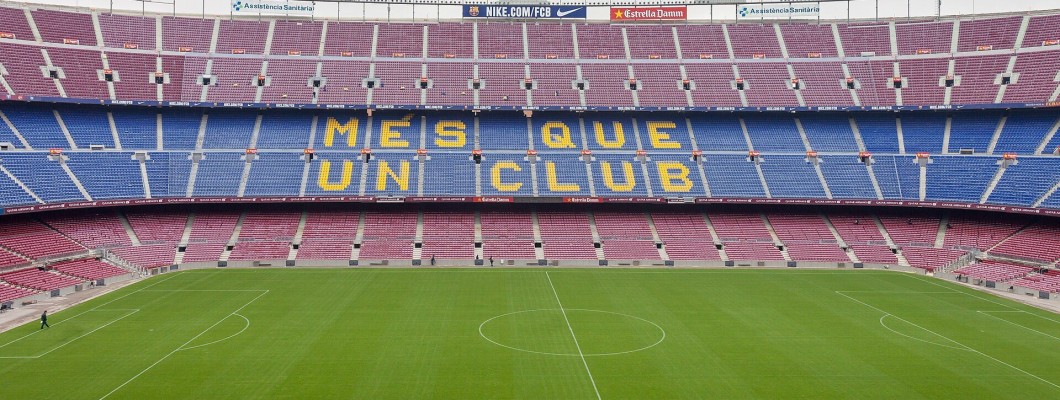
The club's fans are called culés, from the Catalan word for backside. At the Camp de la Indústria, where the team moved in 1909, spectators sitting on top of the stand's wall showed passers-by exactly that part of themselves. Les Corts followed in 1922 and, in 1957, the Camp Nou, which after its refurbishment now carries the name Spotify Camp Nou. The motto "Més que un club", "More than a club", expresses the team's bond with Catalan identity. Barcelona is owned by its members.
107 years without a sponsor
For more than a century the front of the shirt stayed clean. In September 2006 the club agreed to carry the UNICEF logo, with a twist: instead of being paid, it committed to giving the organisation at least 1.5 million euros a year. The Qatar Foundation followed in 2011, then Qatar Airways, Rakuten and, from 2022, Spotify. Among the kit makers, after Meyba in the 1980s and Kappa in 1992-1998, Nike took over in 1998.
From Koeman's Wembley to the sextuple
Johan Cruyff built the so-called Dream Team from 1988, winning four league titles in a row between 1991 and 1994. In 1992, at Wembley, a free kick by Ronald Koeman against Sampdoria gave the club its first European Cup. The titles of 2006, 2009, 2011 and 2015 followed, five in total. In 2009 Barcelona became the first European team to win six competitions in a single year. Anyone who wants to remember those nights can take a look at the Barcelona Champions League winners set of 5 pins.
Happy birthday, Barça. From the eleven men of the Gimnasio Solé to the packed stands of today, the blue and the garnet remain the same.
See Barcelona shirts and merchandise at sportarena.gr.